
 Italian
 English
 French
 German
 Spanish
 Japanese
 Korean
 Vietnamese
 Thai
 Myanmar
 Albanian
 Polish
 Khmer
 Arabic
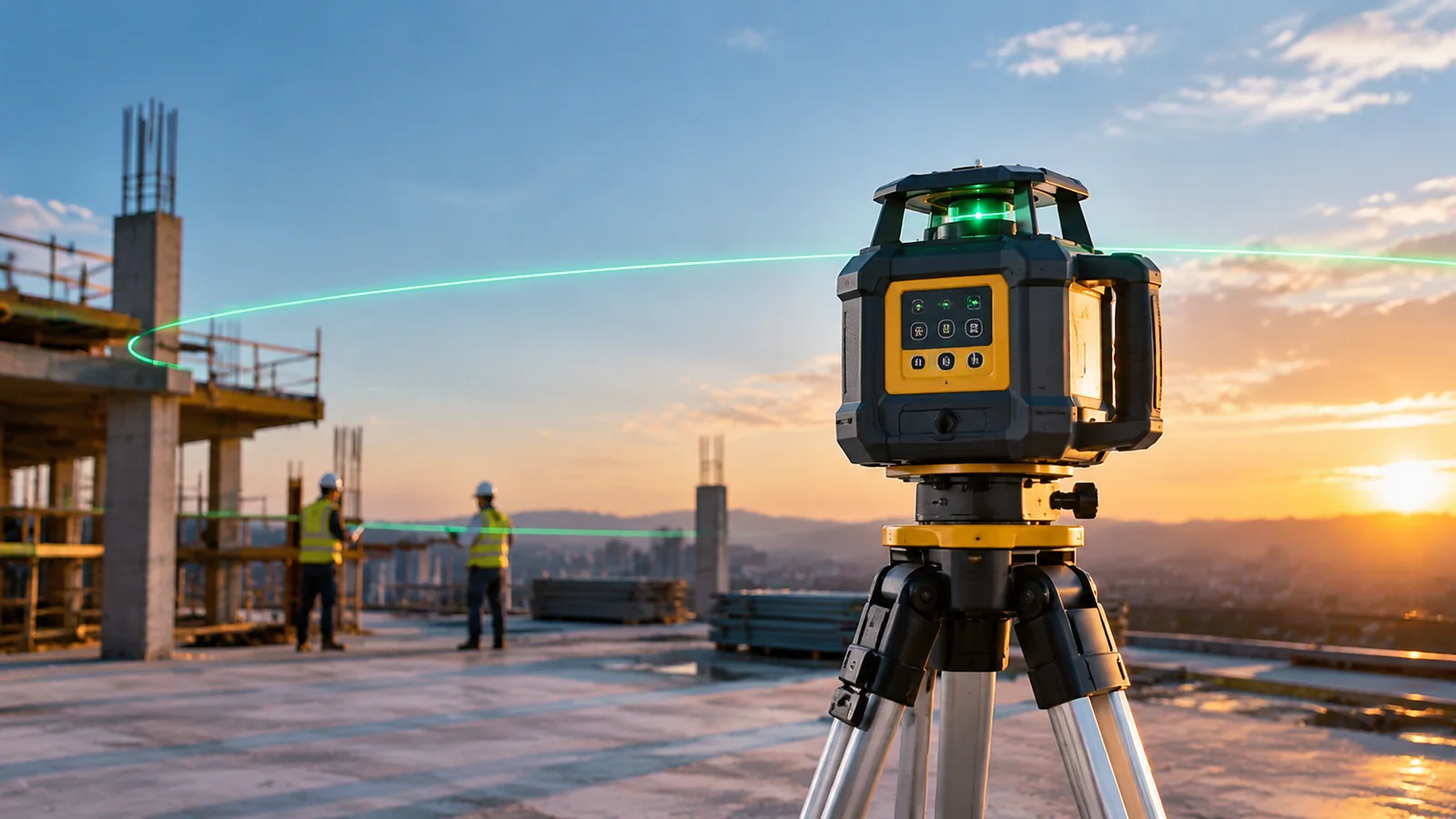
For concrete slab work, select a rotary laser level as a complete elevation-control system: laser, compatible receiver, stable tripod and suitable grade rod. Verify that the proposed kit meets the project’s tolerance and workflow requirements with an on-site acceptance check before committing to multiple units.
This purchasing guide helps contractors, rental businesses and equipment distributors compare working configurations. It focuses on procurement and quality checks; the project team remains responsible for the slab design and measurement plan.
Table of Contents
Start with the slab workflow
Tell the supplier whether the equipment will establish a level reference, help crews check elevations or support a specified slope workflow. Record the working distances, expected site conditions and crew responsibilities. Indoor floor work and outdoor slabs can call for different receiver visibility, mounting and protection requirements.
Separate instrument selection from the finished slab acceptance procedure. A laser reference is one input to the construction process. Surface finish, placement, settlement, measurement method and the project’s inspection plan also affect the result. Buying a laser does not by itself guarantee a compliant floor.
Rotary laser procurement matrix
| Question | Evidence to request | Field check |
|---|---|---|
| Does the kit suit the required task? | Exact model and supported operating modes | Demonstrate the planned level or slope workflow |
| Is the receiver compatible? | Receiver model, detection mode and mounting details | Check readable indications at representative distances |
| Can crews manage disturbances? | Self-leveling limits and alert behavior | Confirm the response to a disturbed setup |
| Are accessories complete? | Tripod, rod, brackets, batteries and charger list | Assemble the full kit before acceptance |
| Is service practical? | Calibration, repair and support arrangements | Agree the escalation and inspection procedure |
1. Compare accuracy statements on the same basis
Read the manufacturer’s accuracy specification together with its distance, conditions and verification procedure. Do not compare two numbers without checking whether they describe the same measurement. Ask what checks the manufacturer recommends before daily operation and after transport or impact.
Define an acceptance method with the responsible project team. Use appropriate reference control and compare observations against the project criteria. Keep the test conditions, setup distances, instrument identification and results. Repeat checks after a suspected disturbance rather than assuming that self-leveling corrects every possible error.
2. Check the receiver and display workflow
Outdoor work often relies on a receiver rather than a visible beam. Confirm compatibility with the exact laser model and intended mode. Review how the receiver indicates high, low and on-grade positions, which sensitivity settings it provides and whether the display is readable in the expected working conditions.
Ask the crew to demonstrate the proposed receiver on the intended rod or mounting bracket. Check how the reference point is read and how the rod is held. Small workflow misunderstandings can create avoidable measurement errors even when both devices function correctly.
3. Understand setup, alerts and rechecks
A stable setup is essential. Confirm the tripod connection, available height range and suitability for the site surface. Keep the instrument away from foreseeable disturbance where practical, and establish who may move or adjust it. A consistent setup procedure helps several crews share the same reference responsibly.
Ask the supplier to demonstrate the unit’s self-leveling process, out-of-range indications and disturbance alerts where provided. Do not assume all models respond in the same way. Document what the crew must do after an alert, battery change, interruption or relocation.
4. Specify the complete kit
Compare itemized packages. A receiver, bracket, grade rod, tripod, charging equipment and case may be sold separately. Check charger input, battery availability and the equipment supplied for the destination market. Obtain written details for any environmental protection claims rather than applying one model’s rating to a whole product family.
K-Level’s public range includes rotary lasers, line lasers, automatic levels and laser accessories. Use the K-Level rotary laser catalog to begin a shortlist, then ask for the exact model documentation and accessory list. A product category is not confirmation of a particular feature or operating specification.
5. Evaluate ownership and fleet support
For contractors and rental companies, compare how units will be checked, maintained and returned to service. Ask about calibration or inspection arrangements, spare receiver availability, repair procedures and written warranty scope. Confirm what support is available for the destination and how a fault is reported.
For distributors, consider a sample kit review before a larger order. Verify packaging, model identification, manuals, accessory completeness and the process for handling a nonconforming unit. Agree batch acceptance criteria and documentation in advance.
RFQ checklist for concrete slab equipment
- Task, working distances and project tolerance requirements.
- Indoor or outdoor environment and expected operating conditions.
- Required operating modes and receiver features.
- Tripod, rod, bracket, batteries, charger and case requirements.
- Quantity, destination and required delivery window.
- Sample evaluation, inspection and documentation requirements.
- Training, service, calibration and spare-parts questions.
Ask each supplier to identify assumptions and exclusions. This makes quotation comparisons more reliable than comparing a bare laser price with a complete contractor kit.
Frequently asked questions
Is a line laser equivalent to a rotary laser for slab work?
They support different workflows and configurations. Compare the required reference, working area, receiver compatibility and project procedure before selecting a type.
Does self-leveling remove the need for field checks?
No. Follow the manufacturer’s instructions and the project’s verification procedure, especially after transport, impact or setup disturbance.
Can any receiver work with any rotary laser?
Do not assume that. Obtain compatibility confirmation for the exact models and operating modes, then test the complete setup.
What should a distributor test in a sample kit?
Check documentation, accessory completeness, setup behavior, receiver operation, agreed measurement checks and the process for support.
How can buyers compare total cost?
Include accessories, power equipment, verification, maintenance, training and service arrangements alongside the purchase price.
Request a matched K-Level equipment quotation
Contact K-Level to request a matched laser-and-receiver configuration. Share the slab workflow, distances, required tolerances, quantity and destination. Ask for an itemized kit list and documentation so your team can review the equipment before purchase.